🎓How I Study AIHISA
📖Read
📄Papers📰Blogs🎬Courses
💡Learn
🛤️Paths📚Topics💡Concepts🎴Shorts
🎯Practice
📝Daily Log🎯Prompts🧠Review
SearchSettings
Chapter 12: A geometric interpretation of Cramer's rule | Essence of Linear Algebra | How I Study AI
📚 선형대수학의 본질12 / 12
PrevComplete
Chapter 12: A geometric interpretation of Cramer's rule | Essence of Linear Algebra
Watch on YouTube

Chapter 12: A geometric interpretation of Cramer's rule | Essence of Linear Algebra

Beginner
3Blue1Brown Korean
AI BasicsYouTube

Key Summary

  • •This lesson explains Cramer's rule using geometry. A linear system like 2x + 5y = 7 and −3x + 4y = −1 can be written as Ax = v, where A’s columns are two vectors a1 and a2. The solution (x, y) tells how much to stretch and add a1 and a2 to land exactly on v.
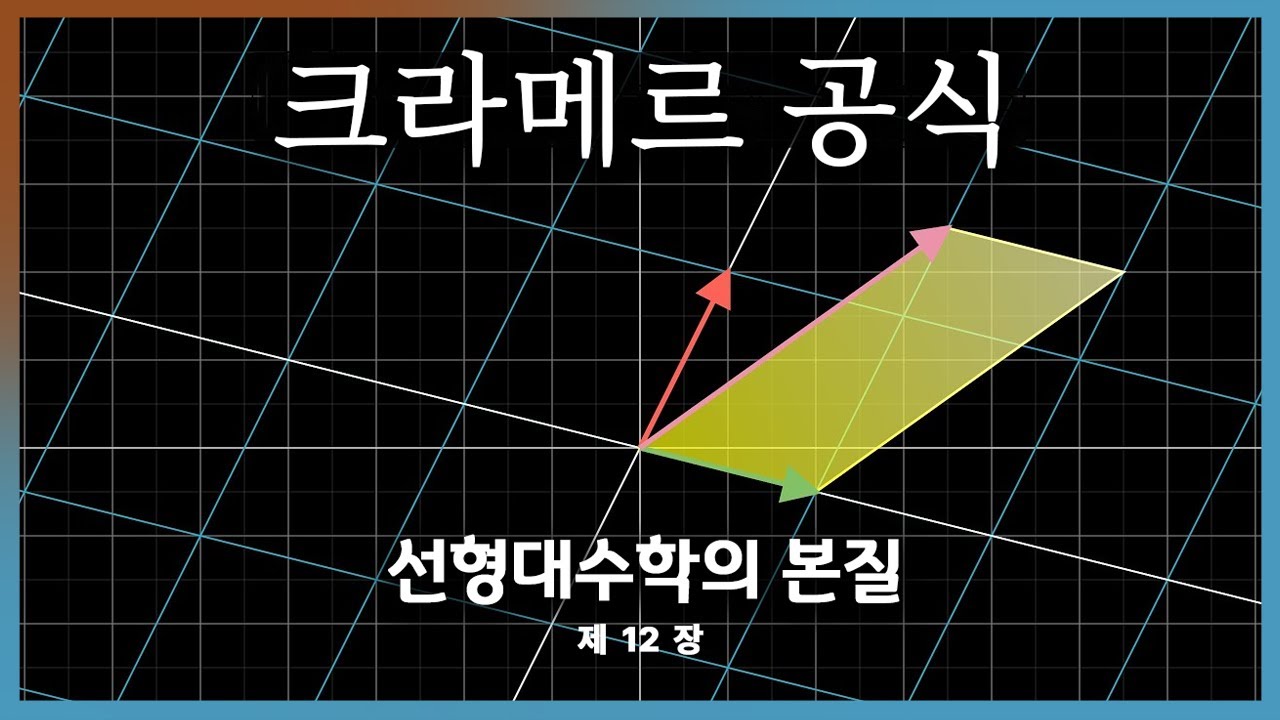
  • •Determinant as area is the key idea. In 2D, det(A) is the signed area of the parallelogram formed by a1 and a2. Replacing a column with v makes new parallelograms whose areas, when compared with det(A), give x and y.
  • •Cramer’s rule says x = det(A_x)/det(A) and y = det(A_y)/det(A). A_x is A with its first column replaced by v; A_y is A with its second column replaced by v. These ratios measure how far along each column direction you must go to reach v.
  • •Geometrically, solving Ax = v is like mixing two direction arrows to land at a target arrow. The numbers x and y are the mix amounts along those arrows. Determinants turn those geometric areas into simple fractions.
  • •Using the example A = [[2, 5], [−3, 4]] and v = [7, −1], det(A) = 23. det(A_x) = 33 and det(A_y) = 19, so x = 33/23 and y = 19/23. Plugging back confirms both equations are satisfied.
  • •If det(A) = 0, the area is zero, meaning the two column vectors lie on the same line. Then there isn’t a unique solution because you can’t form a full parallelogram. The system has either no solution or infinitely many.
  • •The intersection-of-lines view matches the vector-mixing view. Each equation is a line; their intersection gives (x, y). The column interpretation says (x, y) are the exact scaling weights for a1 and a2 to make v.
  • •

Why This Lecture Matters

A geometric grasp of Cramer’s rule is valuable for students, engineers, data analysts, and anyone who solves small systems. Many real-world problems—balances, mixes, and intersections—reduce to linear systems; seeing them as vector combinations makes solutions more intuitive. The determinant-as-area idea links abstract formulas to clear pictures, helping you spot mistakes and reason about signs, magnitudes, and uniqueness before doing any heavy algebra. This is especially helpful for teaching, quick problem solving, and building strong intuition for later topics like linear independence, bases, and transformations. In work and projects, a visual model speeds up sanity checks. For example, when modeling forces, prices, or flows with two factors, you can sketch column directions and predict whether the target is reachable and how large the coefficients should be. When det(A) is small, you’ll anticipate sensitivity and proceed with caution or redesign the system. While Gaussian elimination is the tool of choice for large systems, Cramer’s rule is excellent for exact 2×2 or 3×3 cases and for building the mental model needed to understand matrix inversion and eigenvalues later. Career-wise, mastering geometric interpretations sharpens problem-solving and communication. You can explain solutions to teammates or clients using shapes and areas, not just symbols. In today’s data-driven industry, this clarity is prized: it leads to fewer errors and faster decisions. Ultimately, the technology of determinants and linear systems is a cornerstone of computer graphics, robotics, physics simulations, and optimization—the geometric view is a powerful lens you can apply across them.

Lecture Summary

Tap terms for definitions

01Overview

This lesson teaches a geometric way to understand Cramer’s rule, a method for solving small linear systems like two equations with two unknowns. The main idea is to move from a purely algebraic view—solving lines that intersect—to a vector and area view, where columns of a matrix form a parallelogram, and determinants measure its area. The system Ax = v can be seen as asking: how much of each column vector of A do we need to mix together to land at the target vector v? Cramer’s rule answers that using area ratios.

The lecture begins with a simple 2D system, 2x + 5y = 7 and −3x + 4y = −1. These equations represent two lines in the plane, and their intersection is the solution (x, y). Rewriting this in matrix form gives A = (25−34)\begin{pmatrix} 2 & 5 \\ −3 & 4 \end{pmatrix}(2−3​54​), x = (xy)\begin{pmatrix} x \\ y \end{pmatrix}(xy​)^T, and v = [7, −1]^T, so Ax = v. The columns of A, a1 = [2, −3]^T and a2 = [5, 4]^T, are vectors in the plane. The equation Ax = v is then the same as x⋅a1x·a1x⋅a1 + y⋅a2y·a2y⋅a2 = v, meaning v must be a linear combination—scaled sum—of these two column vectors.

The key geometric concept is the determinant. For a 2x2 matrix, its determinant det⁡(A)\operatorname{det}(A)det(A) is the signed area of the parallelogram spanned by the two column vectors. If we replace one column with the vector v to form a new matrix, say AxA_xAx​ (replace the first column), det⁡(\operatorname{det}(det(A_x))) is the area of the parallelogram spanned by v and the remaining column. The ratios x = det⁡(\operatorname{det}(det(A_x)))/det⁡(A)\operatorname{det}(A)det(A) and y = det⁡(\operatorname{det}(det(A_y)))/det⁡(A)\operatorname{det}(A)det(A) tell precisely the scaling you need along each column to get v. This comes from how area scales with side length: doubling a side doubles area, so area ratios reveal length ratios along directions.

Who is this for? It targets beginners to intermediate learners of linear algebra who want intuition, not just formulas. You should know basic algebra, understand what a matrix and vector are, and be comfortable with solving two equations with two unknowns. No calculus or advanced proofs are required. A very light knowledge of determinants (as a 2x2 product difference ad − bc) helps, but this lesson gives the geometric meaning for deeper understanding.

After finishing, you will be able to interpret a linear system geometrically. You will relate Ax = v to the problem of mixing column vectors to hit a target. You will use determinants as area measures to compute Cramer’s rule in 2D and see how it generalizes to higher dimensions as volumes. You’ll also recognize when a unique solution exists (det⁡(A)\operatorname{det}(A)det(A) ≠ 0) and when it does not (det⁡(A)\operatorname{det}(A)det(A) = 0), and why those cases make sense geometrically.

The lesson is structured in a clear sequence: start with a concrete 2D example of two lines intersecting; rewrite the system in matrix form; interpret columns as direction vectors; define the determinant as the parallelogram’s area; construct AxA_xAx​ and AyA_yAy​ by swapping in v; and finally, interpret x and y as area ratios, giving Cramer’s formulas. The session closes by highlighting that this geometric perspective is not just a trick; it provides a visual, conceptual grasp of why the formulas work. With this, solving small systems isn’t only about plugging numbers but about seeing shapes, areas, and how vectors combine.

Key Takeaways

  • ✓Always rewrite your system as Ax = v first. Identify the columns a1 and a2 because these are your direction arrows. This makes it clear you are searching for weights x and y that mix these arrows to land on v. The setup prevents confusion when forming A_x and A_y later.
  • ✓Compute det(A) before anything else. If it is zero, stop using Cramer’s rule because a unique solution does not exist. Consider alternative methods to check for infinite or no solutions. This saves time and prevents dividing by zero.
  • ✓Use the 2×2 shortcut ad − bc for all determinants. This reduces errors and speeds up computation. Keep track of signs carefully while multiplying. A single sign mistake flips your final answers.
  • ✓Construct A_x and A_y correctly by replacing one column at a time. For A_x, replace the first column with v; for A_y, replace the second column with v. Do not swap rows or both columns at once. Verify you copied numbers accurately.
  • ✓Interpret the ratios geometrically to check your work. If v is close to a2’s direction, expect |y| > |x|. If v is near a1, expect |x| > |y|. When your numbers don’t match the picture, recheck determinants.
  • ✓Expect negative coefficients when v points opposite a column’s arrow. Negative means you move against that direction to reach v. This is normal and matches the signed area idea. Your diagram should show this by the relative orientation.
  • ✓Sketch the columns and the parallelogram whenever you’re unsure. A quick drawing can reveal if your solution is reasonable. Seeing the shape helps detect arithmetic slips early. Visual checks complement numerical work.

Glossary

Linear system

A set of equations where each term is either a number or a number times a variable. In 2D, each equation draws a straight line on a graph. The solution is the point where all the lines meet at the same spot. If two lines are not parallel, they will meet once, giving one solution. If they are the same line, there are many solutions; if parallel and different, no solution.

Matrix

A rectangular grid of numbers arranged in rows and columns. It is like a table that organizes coefficients. Matrices can represent systems of equations or transformations that move and stretch space. A 2×2 matrix has two rows and two columns. Each column can be seen as a direction arrow (vector).

Vector

An ordered list of numbers that can represent a point or an arrow in space. It has direction and length. In 2D, a vector like [a, b] points a units along x and b units along y. Vectors can be added and scaled to make new vectors.

Ax = v

A compact way to write a linear system using a matrix A, an unknown vector x, and a known vector v. It says that when A acts on x, you get v. Interpreted by columns, it means a weighted sum of A’s columns equals v. The weights are the entries of x.

#cramer's rule#determinant#parallelogram area#linear system#matrix#vector#ax=v#linear combination#column vectors#invertible matrix#linear independence#orientation#area scaling#2x2 determinant#parallelepiped#volume#geometric interpretation#basis#span#ill-conditioned
Version: 1
Why determinants? They scale like area when you scale a side of a parallelogram. If v replaces the first column, its area compared to the original area tells how much to scale a1 to reach the same “height” toward v.
  • •Cramer’s rule works in higher dimensions too, replacing area by volume (or hypervolume). det(A) then measures the scaled volume of the box (parallelepiped) formed by columns of A. Each numerator determinant replaces the corresponding column with v.
  • •The signs of determinants track orientation: flipping the order of columns flips the sign. This ensures x and y can be positive or negative depending on direction. Negative means you go opposite the column’s arrow.
  • •Though elimination is faster for big systems, Cramer’s rule gives clear geometry. It reveals exactly how each column contributes to v. This deepens intuition for linear algebra and linear transformations.
  • •In practice, check det(A) first. If it is nonzero, use 2x2 determinant shortcuts to compute x and y quickly. The geometric meaning helps debug mistakes: areas and ratios should match your diagram’s logic.
  • 02Key Concepts

    • 01

      What a linear system is: A linear system is a set of equations where each term is either a constant or a constant times a variable. It’s like two straight roads that might meet at one spot. Technically, in 2D, each equation is a line, and the solution is where the lines cross. It matters because many real problems boil down to finding this crossing point. Example: 2x + 5y = 7 and −3x + 4y = −1 meet at a single point (x, y).

    • 02

      Matrix form Ax = v: This is a compact way to write a system using a matrix A, an unknown vector x, and a known vector v. It’s like packing two equations into one neat box. Technically, A’s columns are vectors that get scaled by x’s entries and added to make v. This matters because it helps us see vector combinations and use matrix tools. Example: A = (25−34)\begin{pmatrix} 2 & 5 \\ −3 & 4 \end{pmatrix}(2−3​54​), x = (xy)\begin{pmatrix} x \\ y \end{pmatrix}(xy​)^T, v = [7,−1]^T, so Ax = v.

    • 03

      Column vectors as directions: Each column of A is a direction arrow in the plane. It’s like two push directions you can mix to move somewhere. Technically, Ax = v means x⋅a1x·a1x⋅a1 + y⋅a2y·a2y⋅a2 = v, a linear combination of columns. This matters because the unknowns x and y are the weights of each direction. Example: a1 = [2, −3]^T and a2 = [5, 4]^T.

    • 04

      Intersection of lines vs. vector mixing: Solving the system equals finding where two lines cross or finding how to mix two arrows to hit a target. It’s like two views of the same puzzle. Technically, line equations and vector sums are equivalent descriptions. This matters because the vector view makes Cramer’s rule and determinants natural. Example: The intersection point gives the same (x, y) as the vector mix that recreates v.

    • 05

      Determinant as area: The determinant det⁡(A)\operatorname{det}(A)det(A) of a 2×22×22×2 matrix is the signed area of the parallelogram formed by its column vectors. It’s like the size of a slanted rectangle made from the two arrows. Technically, \operatorname{det}($$\begin{pmatrix} a & b \\ c & d \end{pmatrix}$$) = ad − bc, and its magnitude is the area. It matters because area scaling links directly to the unknown coefficients. Example: For A = (25−34)\begin{pmatrix} 2 & 5 \\ −3 & 4 \end{pmatrix}(2−3​54​), det⁡(A)\operatorname{det}(A)det(A) = 2⋅42·42⋅4 − 5⋅(5·(5⋅(−3) = 23, the parallelogram area.

    • 06

      Cramer’s rule definition: Cramer’s rule gives x and y by simple fractions of determinants. It’s like using area ratios to find how far along each direction you go. Technically, x = det⁡(\operatorname{det}(det(A_x)))/det⁡(A)\operatorname{det}(A)det(A), y = det⁡(\operatorname{det}(det(A_y)))/det⁡(A)\operatorname{det}(A)det(A), with AxA_xAx​ replacing A’s first column by v and AyA_yAy​ replacing the second. This matters because it’s a direct, formula-based way to solve small systems. Example: For v = [7, −1]^T, x = 33/23 and y = 19/23.

    • 07

      Building AxA_xAx​ and AyA_yAy​: To get AxA_xAx​, replace A’s first column with v; for AyA_yAy​, replace the second column with v. It’s like swapping one direction arrow for the target arrow. Technically, det⁡(\operatorname{det}(det(A_x))) is the area of the parallelogram spanned by v and a2; det⁡(\operatorname{det}(det(A_y))) by a1 and v. It matters because these areas encode the required scaling. Example: AxA_xAx​ = (75−14)\begin{pmatrix} 7 & 5 \\ −1 & 4 \end{pmatrix}(7−1​54​), AyA_yAy​ = (27−3−1)\begin{pmatrix} 2 & 7 \\ −3 & −1 \end{pmatrix}(2−3​7−1​).

    • 08

      Area ratios give coefficients: The ratio det⁡(\operatorname{det}(det(A_x)))/det⁡(A)\operatorname{det}(A)det(A) equals how much to scale a1 to match v’s component in that direction. It’s like comparing the “shadow area” with the original area. Technically, because area scales linearly with the length of each side, replacing a1 with v scales the area in direct proportion to x. This matters because it proves why the fraction gives x. Example: 33/23 is the scale along a1 for the sample.

    • 09

      Non-unique solutions when det⁡(A)\operatorname{det}(A)det(A)=0: If det⁡(A)\operatorname{det}(A)det(A)=0, the parallelogram flattens to a line (area zero). It’s like both arrows pointing in the same or opposite directions. Technically, columns are linearly dependent, so you can’t reach all targets v in a unique way. This matters because Cramer’s rule requires det⁡(A)\operatorname{det}(A)det(A) ≠ 0. Example: If a2 = 2⋅a12·a12⋅a1, the system has no unique solution.

    • 10

      Sign of the determinant: The sign shows orientation, like clockwise vs. counterclockwise order of columns. It’s like a left-hand vs. right-hand turn. Technically, swapping columns flips the sign of det⁡(A)\operatorname{det}(A)det(A). It matters because x and y can be positive or negative depending on direction. Example: If v lies on the opposite side, the area ratio can be negative.

    • 11

      Uniqueness and invertibility: A nonzero determinant means A is invertible and there is exactly one solution. It’s like having two non-parallel directions that span the whole plane. Technically, invertibility ↔ det⁡(A)\operatorname{det}(A)det(A) ≠ 0 ↔ columns are independent. This matters because we can safely apply Cramer’s rule. Example: Our sample A has det 23≠023 ≠ 023=0, so the solution is unique.

    • 12

      Geometric picture of Ax = v: Think of v being inside the parallelogram spanned by a1 and a2. It’s like reaching a point by walking some steps along one arrow and then along the other. Technically, x and y decompose v into the column basis. This matters because it explains existence and size of coefficients. Example: v = x⋅a1x·a1x⋅a1 + y⋅a2y·a2y⋅a2 with x = 33/23, y = 19/23.

    • 13

      Checking solutions visually: You can sketch the arrows and the parallelogram to estimate x and y. It’s like reading a map with two rulers. Technically, projections and relative orientation hint at the sign and magnitude. This matters because it catches arithmetic errors early. Example: If your x is huge but v is near a2, something is off.

    • 14

      Generalization to higher dimensions: In 3D, det⁡(A)\operatorname{det}(A)det(A) is the signed volume of the parallelepiped formed by three columns. It’s like a 3D tilted box. Technically, Cramer’s rule uses volume ratios with one column replaced by v. This matters because the same idea scales up. Example: x1 = det⁡(\operatorname{det}(det(A_1)))/det⁡(A)\operatorname{det}(A)det(A) in 3D.

    • 15

      Why Cramer’s rule is educational: It turns formulas into pictures. It’s like translating math into shapes you can picture. Technically, it shows linearity: determinants change linearly with a single column. It matters because this property underpins the proof and intuition. Example: Doubling one column doubles the determinant.

    • 16

      Comparing to elimination: Gaussian elimination is faster for large systems but less visual. It’s like a powerful machine vs. a clear diagram. Technically, elimination rearranges equations to solve step by step. It matters to know both: speed vs. insight. Example: For 2×22×22×2 or 3×33×33×3, Cramer’s rule is handy and illuminating.

    • 17

      Interpreting zero or negative numerators: If det⁡(\operatorname{det}(det(A_x))) = 0, v aligns with a2, giving x = 0. It’s like all motion happens along the second arrow. Technically, the parallelogram with v and a2 has zero area if they’re collinear. This matters because it confirms direction. Example: If v is a multiple of a2, then y carries everything.

    • 18

      Consistency and reachability: For det⁡(A)\operatorname{det}(A)det(A) ≠ 0, any v in the plane is reachable as x⋅a1x·a1x⋅a1 + y⋅a2y·a2y⋅a2. It’s like having two good levers to move anywhere. Technically, columns span R2R^2R2. This matters for solving arbitrary targets. Example: With independent columns, every v has a unique pair (x, y).

    • 19

      Intersections and slopes connection: From the line view, slopes show if lines intersect uniquely. It’s like seeing if two roads are parallel. Technically, parallel lines mean det⁡(A)\operatorname{det}(A)det(A) = 0. It matters because both views agree. Example: Different slopes → unique crossing → det⁡(A)\operatorname{det}(A)det(A) ≠ 0.

    • 20

      Computational shortcut for 2×22×22×2 determinants: Use ad − bc for (abcd)\begin{pmatrix} a & b \\ c & d \end{pmatrix}(ac​bd​). It’s like a quick area calculator. Technically, it follows from the parallelogram formula. This matters for fast Cramer computations. Example: \operatorname{det}($$\begin{pmatrix} 2 & 5 \\ −3 & 4 \end{pmatrix}$$) = 2⋅42·42⋅4 − 5⋅(5·(5⋅(−3) = 23.

    03Technical Details

    Overall Architecture/Structure

    1. Problem setup: We want to solve a 2D linear system of the form Ax = v, where A is a 2×22×22×2 matrix, x = (xy)\begin{pmatrix} x \\ y \end{pmatrix}(xy​)^T is the unknown vector, and v = (v1v2)\begin{pmatrix} v1 \\ v2 \end{pmatrix}(v1v2​)^T is the known result. In coordinates, this is equivalent to two equations in two unknowns. The matrix’s columns, a1 and a2, serve as direction vectors in the plane. The question becomes: what weights x and y applied to a1 and a2 will land exactly at v?

    2. Geometric interpretation: The columns a1 and a2 define a parallelogram. The determinant det⁡(A)\operatorname{det}(A)det(A) measures the signed area of this parallelogram: positive if the ordered pair (a1, a2) orients counterclockwise, negative if clockwise. If det⁡(A)\operatorname{det}(A)det(A) is zero, the area collapses to zero, meaning the columns are collinear—lying on the same line—and thus cannot span the full plane.

    3. Cramer’s rule structure: Create AxA_xAx​ by replacing the first column of A with v, and AyA_yAy​ by replacing the second column with v. The determinants det⁡(\operatorname{det}(det(A_x))) and det⁡(\operatorname{det}(det(A_y))) measure areas of parallelograms formed by (v, a2) and (a1, v), respectively. The solution is x = det⁡(\operatorname{det}(det(A_x)))/det⁡(A)\operatorname{det}(A)det(A) and y = det⁡(\operatorname{det}(det(A_y)))/det⁡(A)\operatorname{det}(A)det(A). These ratios express how much to scale each direction relative to the base area det⁡(A)\operatorname{det}(A)det(A).

    4. Data flow: Start from A and v. Compute det⁡(A)\operatorname{det}(A)det(A). If det⁡(A)\operatorname{det}(A)det(A) = 0, a unique solution does not exist (either none or infinitely many). Otherwise, compute det⁡(\operatorname{det}(det(A_x))) and det⁡(\operatorname{det}(det(A_y))) and divide by det⁡(A)\operatorname{det}(A)det(A) to get x and y. Optionally verify by plugging back into Ax = v.

    Code/Implementation Details (by hand calculation) Language: Not code-based, but arithmetic steps resemble a procedural algorithm for 2×22×22×2 systems.

    Given A = (abcd)\begin{pmatrix} a & b \\ c & d \end{pmatrix}(ac​bd​) and v = (pq)\begin{pmatrix} p \\ q \end{pmatrix}(pq​), do the following:

    • Compute det⁡(A)\operatorname{det}(A)det(A) = a⋅da·da⋅d − b⋅cb·cb⋅c.
    • Form AxA_xAx​ = (pbqd)\begin{pmatrix} p & b \\ q & d \end{pmatrix}(pq​bd​). Compute det⁡(\operatorname{det}(det(A_x))) = p⋅dp·dp⋅d − b⋅qb·qb⋅q.
    • Form AyA_yAy​ = (apcq)\begin{pmatrix} a & p \\ c & q \end{pmatrix}(ac​pq​). Compute det⁡(\operatorname{det}(det(A_y))) = a⋅qa·qa⋅q − p⋅cp·cp⋅c.
    • Solve x = det⁡(\operatorname{det}(det(A_x)))/det⁡(A)\operatorname{det}(A)det(A) and y = det⁡(\operatorname{det}(det(A_y)))/det⁡(A)\operatorname{det}(A)det(A).

    Explanation of each step:

    • det⁡(A)\operatorname{det}(A)det(A) gives the reference area of the parallelogram spanned by a1 and a2. If this is zero, the area is flat, meaning the system is singular—no unique solution—so stop.
    • det⁡(\operatorname{det}(det(A_x))) swaps in v for a1, so it measures how much of v aligns with the direction that pairs with a2 to produce the needed area. Since area scales linearly with the length of one side while keeping the other side fixed, det⁡(\operatorname{det}(det(A_x)))/det⁡(A)\operatorname{det}(A)det(A) is the fraction describing how much a1 must be scaled to match v’s contribution in that direction, giving x.
    • det⁡(\operatorname{det}(det(A_y))), similarly, measures how much v contributes relative to a1, giving y via det⁡(\operatorname{det}(det(A_y)))/det⁡(A)\operatorname{det}(A)det(A).

    Detailed Walkthrough With the Sample System System: 2x + 5y = 7, −3x + 4y = −1.

    • A = (25−34)\begin{pmatrix} 2 & 5 \\ −3 & 4 \end{pmatrix}(2−3​54​), v = [7, −1].
    • Column vectors: a1 = [2, −3]^T, a2 = [5, 4]^T.
    • det⁡(A)\operatorname{det}(A)det(A) = 2⋅42·42⋅4 − 5⋅(5·(5⋅(−3) = 8 + 15 = 23. Geometrically, this is the area of the parallelogram spanned by a1 and a2.
    • AxA_xAx​ = (75−14)\begin{pmatrix} 7 & 5 \\ −1 & 4 \end{pmatrix}(7−1​54​). det⁡(\operatorname{det}(det(A_x))) = 7⋅47·47⋅4 − 5⋅(5·(5⋅(−1) = 28 + 5 = 33.
    • AyA_yAy​ = (27−3−1)\begin{pmatrix} 2 & 7 \\ −3 & −1 \end{pmatrix}(2−3​7−1​). det⁡(\operatorname{det}(det(A_y))) = 2⋅(2·(2⋅(−1) − 7⋅(7·(7⋅(−3) = −2 + 21 = 19.
    • x = det⁡(\operatorname{det}(det(A_x)))/det⁡(A)\operatorname{det}(A)det(A) = 33/23, y = det⁡(\operatorname{det}(det(A_y)))/det⁡(A)\operatorname{det}(A)det(A) = 19/23.
    • Check: Ax = [2⋅(332·(332⋅(33/23) + 5⋅(195·(195⋅(19/23), −3⋅(333·(333⋅(33/23) + 4⋅(194·(194⋅(19/23)] = [7, −1] = v.

    Why Area Ratios Work (Technical Intuition)

    • Determinant linearity in each column: If you scale one column by a factor k (keeping the other fixed), the determinant scales by k. This reflects area scaling: doubling one side of a parallelogram doubles its area.
    • Replacement by v: Consider det⁡(\operatorname{det}(det(A_x))) with (v, a2). If v happens to be x⋅a1x·a1x⋅a1 + y⋅a2y·a2y⋅a2, and you hold a2 fixed, the area under linearity becomes det⁡(\operatorname{det}(det(x·a1+++y·a2,a2), a2),a2) = x·det⁡(a1,a2)\operatorname{det}(a1, a2)det(a1,a2) + y·det⁡(a2,a2)\operatorname{det}(a2, a2)det(a2,a2). The second term is zero since det⁡(a2,a2)\operatorname{det}(a2, a2)det(a2,a2) = 0 (collinear vectors give zero area). Thus det⁡(\operatorname{det}(det(A_x))) = x·det⁡(A)\operatorname{det}(A)det(A), implying x = det⁡(\operatorname{det}(det(A_x)))/det⁡(A)\operatorname{det}(A)det(A). A similar argument gives y = det⁡(\operatorname{det}(det(A_y)))/det⁡(A)\operatorname{det}(A)det(A).
    • Orientation and sign: If v points roughly opposite to a1’s direction while paired with a2, det⁡(\operatorname{det}(det(A_x))) can be negative, leading to a negative x, which correctly represents moving against a1’s arrow.

    Tools/Libraries Used

    • None required. The method is purely arithmetic and geometric. For 2×22×22×2 matrices, hand calculation is straightforward using ad − bc. For visualization, sketching vectors on graph paper or a plotting tool can help but is optional.

    Step-by-Step Implementation Guide (Practical How-To)

    1. Write the system in matrix form: Identify A, x, and v so that Ax = v. Place coefficients of x and y into A’s columns.
    2. Compute det⁡(A)\operatorname{det}(A)det(A): For A = (abcd)\begin{pmatrix} a & b \\ c & d \end{pmatrix}(ac​bd​), calculate ad − bc. If the result is zero, stop; the system has no unique solution.
    3. Build AxA_xAx​ and AyA_yAy​: Replace the first column of A by v to form AxA_xAx​. Replace the second column by v to form AyA_yAy​.
    4. Compute determinants: Find det⁡(\operatorname{det}(det(A_x))) and det⁡(\operatorname{det}(det(A_y))) using the 2×22×22×2 formula.
    5. Solve: x = det⁡(\operatorname{det}(det(A_x)))/det⁡(A)\operatorname{det}(A)det(A), y = det⁡(\operatorname{det}(det(A_y)))/det⁡(A)\operatorname{det}(A)det(A).
    6. Verify: Multiply A by (xy)\begin{pmatrix} x \\ y \end{pmatrix}(xy​)^T and confirm the result equals v. Optionally, also check the original line equations.
    7. Visual check (optional): Sketch a1 and a2; draw their parallelogram. Place v and see if the ratios make visual sense (e.g., if v is closer to a2, expect y’s magnitude to be relatively larger).

    Tips and Warnings

    • Always check det⁡(A)\operatorname{det}(A)det(A) first. If it’s zero, there is no unique solution; Cramer’s rule is not applicable. Consider other methods (e.g., substitution, elimination) to explore if there are infinitely many or no solutions.
    • Keep track of signs. A small arithmetic slip (like sign errors in ad − bc) can flip the solution’s direction. Use parentheses and double-check multiplications.
    • Scale intuition: If you scale a1 by k, expect det⁡(A)\operatorname{det}(A)det(A) to scale by k and x to adjust accordingly if the target v stays the same. This can help you anticipate the rough size of x and y.
    • Geometric sanity checks: If v is nearly parallel to a2, det⁡(\operatorname{det}(det(A_y))) should be relatively large in magnitude compared to det⁡(\operatorname{det}(det(A_x))), suggesting |y| is larger than |x|. If v lies almost exactly along a1, expect y≈0y ≈ 0y≈0.
    • Efficiency note: For large systems (n > 3), Gaussian elimination or matrix inversion is typically more efficient numerically. Cramer’s rule shines most as an explanatory tool and for small, exact calculations.
    • Orientation awareness: Swapping the order of A’s columns flips the sign of det⁡(A)\operatorname{det}(A)det(A) and swaps the roles of x and y. If you reorder columns, treat v and the unknown vector components accordingly.
    • Degenerate geometry: If a1 and a2 are very close to collinear (det⁡(A)\operatorname{det}(A)det(A) near zero), the system is sensitive to small changes (ill-conditioned). Expect very large x or y if v is not perfectly aligned, and be careful with rounding.

    Extending the Geometry to 3D (for insight)

    • In 3D, A is 3×33×33×3 with columns a1, a2, a3 forming a parallelepiped (a slanted 3D box). det⁡(A)\operatorname{det}(A)det(A) is the signed volume of this shape. To solve Ax = v where x = (x1x2x3)\begin{pmatrix} x1 \\ x2 \\ x3 \end{pmatrix}​x1x2x3​​^T, Cramer’s rule says xi = det⁡(\operatorname{det}(det(A_i)))/det⁡(A)\operatorname{det}(A)det(A) where AiA_iAi​ is A with the i-th column replaced by v.
    • The same linearity idea applies: the determinant is linear in each column while other columns are fixed. Replace one column by the vector v = x1⋅a1x1·a1x1⋅a1 + x2⋅a2x2·a2x2⋅a2 + x3⋅a3x3·a3x3⋅a3, and all terms vanish except the one with the matching column, giving xi·det⁡(A)\operatorname{det}(A)det(A). This locks in the ratio.
    • While the computations grow for larger matrices, the geometric interpretation remains: ratios of volumes yield the scaling along each basis direction.

    Putting It All Together

    • Two perspectives—line intersections and vector mixing—are the same problem dressed differently. Determinants bridge them by quantifying area (or volume) in a way that respects linear scaling. Cramer’s rule reads these areas as the exact mix ratios.
    • The sample system illustrates everything numerically. The determinant 23 sets the base area. Replacing a column with v produces areas 33 and 19, whose ratios to 23 are exactly the required scales along the first and second columns. This is both a calculation shortcut for 2×22×22×2 systems and a window into the geometry of linear algebra.

    04Examples

    • 💡

      Solving the sample system: Take A = (25−34)\begin{pmatrix} 2 & 5 \\ −3 & 4 \end{pmatrix}(2−3​54​) and v = [7, −1]. Compute det⁡(A)\operatorname{det}(A)det(A) = 23, det⁡(\operatorname{det}(det(A_x))) = 33, det⁡(\operatorname{det}(det(A_y))) = 19. Then x = 33/23 and y = 19/23. Plugging back gives [7, −1], confirming the solution. The key point is that area ratios directly yield the coefficients.

    • 💡

      When det⁡(A)\operatorname{det}(A)det(A)=0 (parallel columns): Let a1 = [2, 4] and a2 = [1, 2], so a2 = 0.5⋅a15·a15⋅a1. Then det⁡(A)\operatorname{det}(A)det(A) = 2⋅22·22⋅2 − 4⋅14·14⋅1 = 0, meaning the parallelogram area is zero. For v = [3, 6], there are infinitely many solutions along that line; for v = [3, 5], there is no solution. The key point is that a flat area signals non-unique or inconsistent systems.

    • 💡

      Zero numerator meaning x=0: Suppose a1 = [1, 0], a2 = [0, 2], and v = [0, 3]. Here det⁡(A)\operatorname{det}(A)det(A) = 1⋅21·21⋅2 − 0 = 2. AxA_xAx​ replaces a1 with v: det⁡(\operatorname{det}(det(A_x))) = 0⋅20·20⋅2 − 0⋅30·30⋅3 = 0, so x = 0. The key point is that if v aligns with a2, the needed contribution along a1 is zero.

    • 💡

      Negative coefficient: Let a1 = [2, 0], a2 = [1, 1], and v = [0, 1]. det⁡(A)\operatorname{det}(A)det(A) = 2⋅12·12⋅1 − 0⋅10·10⋅1 = 2. AxA_xAx​ = (0111)\begin{pmatrix} 0 & 1 \\ 1 & 1 \end{pmatrix}(01​11​) gives det⁡(\operatorname{det}(det(A_x))) = 0⋅10·10⋅1 − 1⋅11·11⋅1 = −1, so x = −1/2. This shows moving opposite to a1’s direction is captured by a negative ratio.

    • 💡

      Visual closeness and sizes: Let a1 = [1, 0], a2 = [1, 2], and v = [1, 1.8]. det⁡(A)\operatorname{det}(A)det(A) = 1⋅21·21⋅2 − 0⋅10·10⋅1 = 2. AxA_xAx​ = (111.82)\begin{pmatrix} 1 & 1 \\ 1.8 & 2 \end{pmatrix}(11.8​12​) gives det⁡(\operatorname{det}(det(A_x))) = 1⋅21·21⋅2 − 1⋅11·11⋅1.8 = 0.2, so x = 0.1; AyA_yAy​ = (1101.8)\begin{pmatrix} 1 & 1 \\ 0 & 1.8 \end{pmatrix}(10​11.8​) gives 1⋅11·11⋅1.8 − 1⋅01·01⋅0 = 1.8, so y = 0.9. The key point is v closer to a2 makes y much larger than x.

    • 💡

      Swapping column order: Start with A = (1201)\begin{pmatrix} 1 & 2 \\ 0 & 1 \end{pmatrix}(10​21​). det⁡(A)\operatorname{det}(A)det(A) = 1⋅11·11⋅1 − 2⋅02·02⋅0 = 1. If you swap columns, A' = (2110)\begin{pmatrix} 2 & 1 \\ 1 & 0 \end{pmatrix}(21​10​), det⁡(A′)\operatorname{det}(A')det(A′) = −1. Solving Ax = v and A'x' = v gives related solutions with swapped roles and possibly sign shifts. The key point is orientation changes sign but doesn’t break the method.

    • 💡

      Consistency check by lines: For 2x + 4y = 8 and x + 2y = 4, the lines are the same (second is half the first). Matrix A = (2412)\begin{pmatrix} 2 & 4 \\ 1 & 2 \end{pmatrix}(21​42​) has det⁡(A)\operatorname{det}(A)det(A)=0. Thus, either infinite solutions or constraints depend on v. The key point is both line-slope logic and determinant logic agree.

    • 💡

      Almost parallel columns (ill-conditioned): Let a1 = [1, 1], a2 = [1.001, 1]. det⁡(A)\operatorname{det}(A)det(A) ≈ 1⋅11·11⋅1 − 1⋅11·11⋅1.001 = −0.001. For v near [2, 2], small changes in v cause large changes in x and y. The key point is a tiny determinant means sensitive solutions.

    • 💡

      Pure a1 direction: Let a1 = [3, 1], a2 = [0, 2], v = 5⋅a15·a15⋅a1 = [15, 5]. det⁡(A)\operatorname{det}(A)det(A) = 3⋅23·23⋅2 − 0⋅10·10⋅1 = 6. AxA_xAx​ = (15052)\begin{pmatrix} 15 & 0 \\ 5 & 2 \end{pmatrix}(155​02​) gives det⁡(\operatorname{det}(det(A_x))) = 15⋅215·215⋅2 − 0⋅50·50⋅5 = 30, so x = 5; AyA_yAy​ = (31515)\begin{pmatrix} 3 & 15 \\ 1 & 5 \end{pmatrix}(31​155​) gives 3⋅53·53⋅5 − 15⋅115·115⋅1 = 0, so y = 0. The key point is the ratios exactly match the expected multiples.

    • 💡

      Pure a2 direction: Let a1 = [2, −1], a2 = [1, 3], v = −2⋅a22·a22⋅a2 = [−2, −6]. det⁡(A)\operatorname{det}(A)det(A) = 2⋅32·32⋅3 − (−1)⋅11)·11)⋅1 = 7. AxA_xAx​ = (−21−63)\begin{pmatrix} −2 & 1 \\ −6 & 3 \end{pmatrix}(−2−6​13​) gives det⁡(\operatorname{det}(det(A_x))) = −2⋅32·32⋅3 − 1⋅(1·(1⋅(−6) = 0 → x = 0; AyA_yAy​ = (2−2−1−6)\begin{pmatrix} 2 & −2 \\ −1 & −6 \end{pmatrix}(2−1​−2−6​) gives 2⋅(2·(2⋅(−6) − (−2)⋅(2)·(2)⋅(−1) = −12 − 2 = −14 → y = −2. The key point is direction and sign are captured cleanly.

    • 💡

      Target outside parallelogram but still reachable: Let a1 = [1, 0], a2 = [0, 1], v = [3, 4]. det⁡(A)\operatorname{det}(A)det(A) = 1. AxA_xAx​ = (3041)\begin{pmatrix} 3 & 0 \\ 4 & 1 \end{pmatrix}(34​01​) gives 3⋅13·13⋅1 − 0⋅40·40⋅4 = 3 → x = 3; AyA_yAy​ = (1304)\begin{pmatrix} 1 & 3 \\ 0 & 4 \end{pmatrix}(10​34​) gives 1⋅41·41⋅4 − 3⋅03·03⋅0 = 4 → y = 4. The key point is the parallelogram spans the whole plane, so any v works.

    • 💡

      Near-zero x: Let a1 = [2, 0], a2 = [1, 5], v = [1, 5.1]. det⁡(A)\operatorname{det}(A)det(A) = 2⋅52·52⋅5 − 0⋅10·10⋅1 = 10. AxA_xAx​ = (115.15)\begin{pmatrix} 1 & 1 \\ 5.1 & 5 \end{pmatrix}(15.1​15​) gives 1⋅51·51⋅5 − 1⋅51·51⋅5.1 = −0.1 → x = −0.01; AyA_yAy​ = (2105.1)\begin{pmatrix} 2 & 1 \\ 0 & 5.1 \end{pmatrix}(20​15.1​) gives 2⋅52·52⋅5.1 − 1⋅01·01⋅0 = 10.2 → y = 1.02. The key point is v almost along a2 leads to tiny x.

    • 💡

      Zero determinant, no solution: Let a1 = [1, 2], a2 = [2, 4], and v = [1, 3]. det⁡(A)\operatorname{det}(A)det(A) = 1⋅41·41⋅4 − 2⋅22·22⋅2 = 0. The lines are parallel but not the same, so no point satisfies both. Cramer’s rule cannot be used. The key point is det⁡(A)\operatorname{det}(A)det(A) = 0 flags inconsistency or non-uniqueness.

    • 💡

      Changing v changes numerators, not denominator: With fixed A, det⁡(A)\operatorname{det}(A)det(A) stays the same. Different targets v only change det⁡(\operatorname{det}(det(A_x))) and det⁡(\operatorname{det}(det(A_y))). This means the base area is a constant scale, and v adjusts how much of each direction is needed. The key point is to compute det⁡(A)\operatorname{det}(A)det(A) once and reuse for multiple v.

    • 💡

      3D analogy: Take A with three independent columns in 3D; det⁡(A)\operatorname{det}(A)det(A) is the volume of their box. Replacing one column with v gives a new box whose volume relative to the original gives the corresponding coordinate. Although not computed here, the same logic applies. The key point is area becomes volume in higher dimensions.

    05Conclusion

    This lesson re-frames solving small linear systems as a geometric exercise. Instead of just intersecting lines, we see the system Ax = v as mixing two direction arrows—A’s columns—to land at a target arrow v. The determinant det⁡(A)\operatorname{det}(A)det(A) provides the base area of the parallelogram built by these two directions, and replacing a column with v yields new parallelogram areas. Cramer’s rule then expresses the unknown coefficients x and y as the simple ratios x = det⁡(\operatorname{det}(det(A_x)))/det⁡(A)\operatorname{det}(A)det(A) and y = det⁡(\operatorname{det}(det(A_y)))/det⁡(A)\operatorname{det}(A)det(A). This follows from the linearity of the determinant in each column: scaling one side scales the area in the same way.

    The numerical example with A = (25−34)\begin{pmatrix} 2 & 5 \\ −3 & 4 \end{pmatrix}(2−3​54​) and v = [7, −1] makes the idea concrete: det⁡(A)\operatorname{det}(A)det(A) = 23, det⁡(\operatorname{det}(det(A_x))) = 33, det⁡(\operatorname{det}(det(A_y))) = 19, thus x = 33/23 and y = 19/23. Geometrically, these are exactly how far along a1 and a2 we must travel to reach v. If det⁡(A)\operatorname{det}(A)det(A) were zero, the area would vanish, signaling non-uniqueness; the columns would lie on the same line and fail to span the plane. Orientation and sign make the method sensitive to direction—negative results mean moving opposite a column’s arrow.

    To practice, start by writing systems in Ax = v form and sketching the column vectors. Compute det⁡(A)\operatorname{det}(A)det(A) to ensure a unique solution, then build AxA_xAx​ and AyA_yAy​ and find the ratios. Try special cases where v aligns with one column, or where columns are nearly parallel, to see how the numbers behave. Extend your mental model to 3D by imagining volume instead of area.

    As a next step, learn Gaussian elimination and matrix inverses to handle larger systems efficiently, while keeping this geometric intuition as your guide. Explore topics like linear independence, span, basis, and transformations to deepen your understanding of how matrices shape space. The core message to remember: determinants turn geometry into numbers. With Cramer’s rule, those numbers become exact mix amounts along each column direction, making the solution not just a pair of values, but a picture you can see.

  • ✓Recognize sensitivity when det(A) is small. Nearly parallel columns create large coefficients and unstable answers. Be especially careful with rounding or measurement noise. Consider re-scaling or choosing a better basis if possible.
  • ✓Reuse det(A) for different targets v when A stays the same. Compute det(A) once, and only update det(A_x) and det(A_y) for new v. This speeds up solving multiple related problems. It also reinforces the base area idea.
  • ✓Compare with the line-intersection view for intuition. Different slopes imply a single crossing and nonzero determinant. Same slope implies determinant zero and no unique solution. Both views should tell the same story.
  • ✓Remember the reason Cramer’s rule works: determinant linearity in each column. Replacing a column with v splits the area into a sum, and only the matching term survives. This gives the clean ratio for the desired coefficient. Keeping this proof sketch in mind strengthens understanding.
  • ✓Use Cramer’s rule mainly for 2×2 and 3×3 systems. For bigger systems, switch to Gaussian elimination or matrix factorization. This balances clarity and efficiency. You’ll still keep the geometric intuition for guidance.
  • ✓Check units and scaling if your system comes from a real model. Large det(A) suggests area expansion; very small det(A) warns of potential instability. If your coefficients have physical units, make sure solutions have consistent units too. This avoids modeling mistakes.
  • ✓Practice with edge cases to build confidence. Try v aligned with a1 or a2 to predict zeros in numerators. Try nearly parallel columns to see large coefficients. These drills make the geometry second nature.
  • ✓Keep orientation in mind when columns are swapped. Swapping columns flips det(A)’s sign and changes which ratio corresponds to which variable. Update your interpretation and variables accordingly. This prevents silent sign errors.
  • Column vector

    A vector written as a single column of numbers. Each column of a matrix can be treated as a direction arrow. These columns can be combined by scaling and adding to reach other vectors. In Ax = v, the unknowns are the scale amounts for each column.

    Linear combination

    A sum of vectors where each vector is multiplied by a number first. It is like mixing ingredients in set amounts. If v = x·a1 + y·a2, then v is a linear combination of a1 and a2. The numbers x and y are the coefficients.

    Determinant

    A number computed from a square matrix that measures scaling of area (in 2D) or volume (in 3D) under the related transformation. For a 2×2 matrix [[a, b], [c, d]], it is ad − bc. If it is zero, the transformation squashes space flat along some direction. The sign shows orientation, and the size shows how big the area or volume becomes.

    Parallelogram

    A four-sided shape where opposite sides are parallel. Two vectors in 2D form a parallelogram when placed tail-to-tail. Its area is a measure of how much space those two directions cover together. The determinant of their matrix gives this signed area.

    +28 more (click terms in content)