🎓How I Study AIHISA
📖Read
📄Papers📰Blogs🎬Courses
💡Learn
🛤️Paths📚Topics💡Concepts🎴Shorts
🎯Practice
📝Daily Log🎯Prompts🧠Review
SearchSettings
Chapter 6: The determinant | Essence of Linear Algebra | How I Study AI
📚 선형대수학의 본질7 / 12
PrevNext
Chapter 6: The determinant | Essence of Linear Algebra
Watch on YouTube

Chapter 6: The determinant | Essence of Linear Algebra

Beginner
3Blue1Brown Korean
AI BasicsYouTube

Key Summary

  • •The determinant is a single number attached to every square matrix that tells how a linear transformation scales area in 2D or volume in 3D. Its absolute value is the scale factor, and its sign tells whether the transformation keeps orientation or flips it. Think of dropping a 1-by-1 square (or 1-by-1-by-1 cube) into the transformation and measuring what size it becomes.
  • •In 2D, the determinant of a matrix with columns [a, c] and [b, d] equals ad − bc. This number is the signed area of the parallelogram made by the images of the standard basis arrows i-hat and j-hat. Large a and d stretch mainly along their original axes, while large b and c shear, slanting i-hat and j-hat toward each other.
  • •A positive determinant means the transformation keeps orientation (the order of i-hat then j-hat stays counterclockwise). A negative determinant means it flips orientation, like a mirror reflection that turns right-handed order into left-handed order. The size of the determinant still gives the area change.
  • •In 3D, the determinant measures how a unit cube’s volume changes under the transformation. A determinant of 8 means every small volume becomes 8 times bigger; −8 means the same size change but with a handedness flip (right-hand system becomes left-hand).
  • •Determinants multiply under composition: det(AB) = det(A) × det(B). If A doubles area and B triples area, doing A then B multiplies areas by 6 overall. This rule matches how we expect scaling to stack.
  • •A determinant of 0 means the transformation squashes space into a lower dimension. In 2D, everything is flattened onto a line, so area becomes 0; in 3D, space may flatten into a plane, so volume becomes 0. This also means the matrix is not invertible.
  • •

Why This Lecture Matters

Understanding determinants through geometry helps students, engineers, data scientists, and developers reason about matrices without heavy algebra. It quickly answers practical questions: Does a matrix collapse space (det = 0)? Does it keep or flip orientation (sign of det)? By seeing the determinant as an area/volume scale, you can predict behavior in graphics pipelines, coordinate changes, simulation steps, and robotics transformations. This knowledge solves recurring problems: checking invertibility before attempting to solve linear systems, estimating how much a transformation magnifies errors or noise, and understanding why certain pipelines lose information. In real projects, you often compose many transformations; knowing det(AB) = det(A)det(B) lets you track the overall scale instantly. In optimization and physics, similar ideas appear in change of variables and volume preservation, where determinants say how densities or volumes evolve. Career-wise, a strong geometric feel for determinants builds confidence to tackle advanced topics. It supports later work in multivariable calculus (Jacobians), computer graphics (transform stacks), machine learning (feature transforms), and control systems (state-space models). In today’s industry, where data and geometry meet often, this mental model is a lasting tool: it speeds up debugging, improves design choices, and makes math less about memorizing and more about understanding.

Lecture Summary

Tap terms for definitions

01Overview

This lesson builds a clear, picture-first understanding of the determinant, a single number defined for every square matrix. The central idea is simple: view a matrix as a linear transformation, which is a rule that moves vectors in a straight, grid-respecting way. Then, watch what happens to a unit shape under that transformation—a 1-by-1 square in 2D or a 1-by-1-by-1 cube in 3D. The determinant tells you how much the transformation stretches or shrinks that shape and whether it flips its orientation, like switching from a right-hand to a left-hand system.

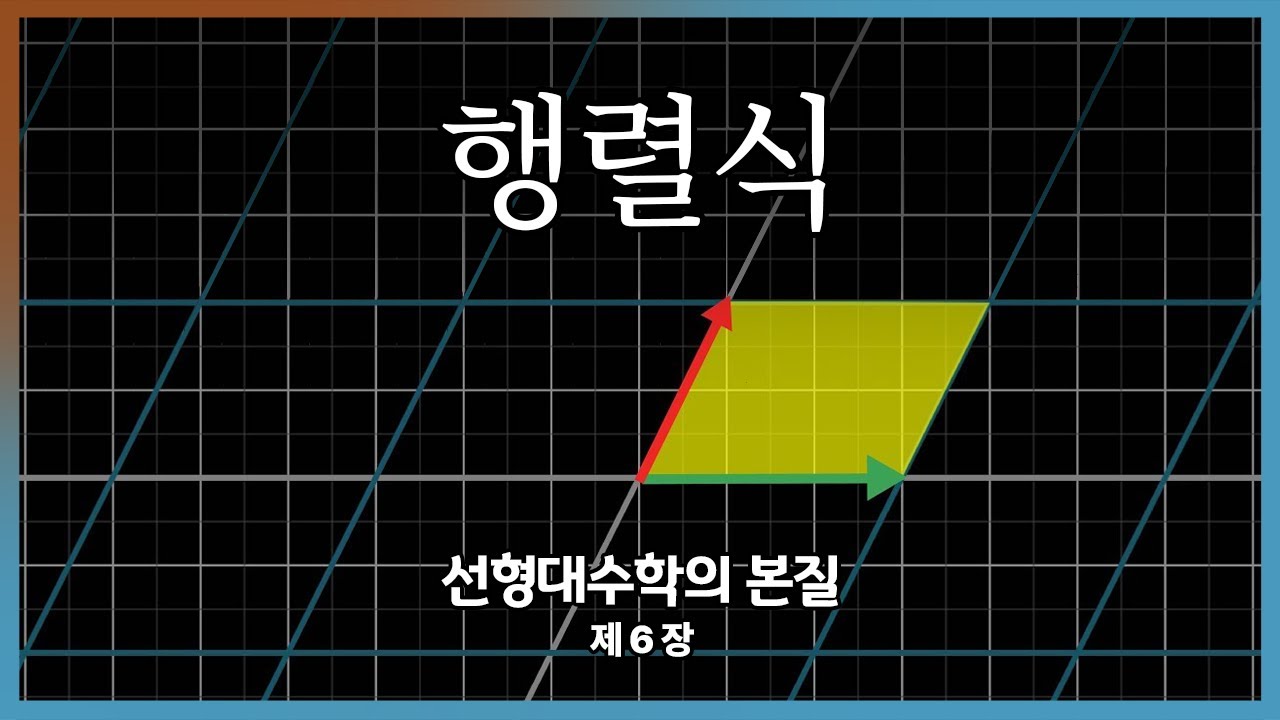
Starting in 2D, the determinant measures the signed area scaling of the unit square. If i-hat (the standard unit vector along x) moves to some new vector, and j-hat (the standard unit vector along y) moves to another vector, these two images form a parallelogram. The area of that parallelogram, with a sign that indicates orientation, is the determinant. For a 2×22×22×2 matrix with columns (ac)\begin{pmatrix} a \\ c \end{pmatrix}(ac​) and (bd)\begin{pmatrix} b \\ d \end{pmatrix}(bd​), the determinant equals ad − bc. This compact formula matches the picture: it is the signed area of the parallelogram formed by those two column vectors.

The sign of the determinant matters. A positive sign means orientation is preserved—the order of i-hat then j-hat still goes counterclockwise. A negative sign means the order is flipped, like a mirror image, so the system’s “handedness” changes. The absolute value of the determinant gives the scale factor for area in 2D (or volume in 3D). For example, a transformation that stretches x by 3 and y by 2 has determinant 6, because the unit square becomes a rectangle with area 6.

In 3D, the same idea holds, now with volume. The determinant tells how a unit cube’s volume changes. For example, stretching x, y, and z each by 2 multiplies volume by 8, so the determinant is 8. If one axis is also flipped, the determinant becomes −8, showing that handedness is reversed while the size scaling is the same.

A powerful property ties everything together: determinants multiply under composition. If matrix A doubles area and matrix B triples it, doing A then B multiplies area by 6 overall. This is the statement det⁡(AB)\operatorname{det}(AB)det(AB) = det⁡(A)\operatorname{det}(A)det(A) × det⁡(B)\operatorname{det}(B)det(B). This rule matches our intuition about stacking transformations and gives a quick way to reason about how complicated combinations scale space.

Another crucial case is when the determinant equals zero. Geometrically, this means space collapses into a lower dimension. In 2D, all points get pushed onto a line, making any area zero; in 3D, space might flatten into a plane, making any volume zero. A zero determinant signals that the transformation loses information and cannot be reversed. It also foreshadows the link to solving linear systems: zero determinant means no unique solution.

Who is this for? The lesson is aimed at beginners and anyone who prefers intuition before formulas. You should know what matrices and vectors are, what matrix multiplication does (it composes transformations), and recognize the standard basis vectors i-hat, j-hat, and k-hat. No heavy algebra is required, because the focus is on understanding via pictures and simple examples.

After finishing, you will be able to: describe the determinant as a signed area or volume scale; decide whether a transformation keeps or flips orientation; quickly estimate a determinant’s sign and magnitude by visualizing where the basis vectors go; explain why determinants multiply under composition; and recognize that a zero determinant means dimension collapse and no inverse. These skills help in real tasks like checking if a matrix is invertible, understanding shape changes in graphics, and anticipating solution behavior in linear systems.

The lesson’s flow moves from simple to general. First, it defines the determinant in 2D using the unit square and the parallelogram made by the images of i-hat and j-hat. Next, it shows the 2×22×22×2 formula ad − bc and explains how diagonal stretching versus shearing affect the number. Then, it explores the sign as a marker of orientation and shows examples, including reflections. The idea is extended to 3D with unit cubes and handedness. Finally, it presents the multiplicative rule det⁡(AB)\operatorname{det}(AB)det(AB) = \operatorname{det}(A)$$\operatorname{det}(B) and explains the meaning of a zero determinant as collapse to a lower dimension. The closing note sets up a future link to how determinants relate to solving systems of linear equations.

Key Takeaways

  • ✓Always read the columns first: they show where i-hat, j-hat, k-hat go. Sketch them from the origin to see the new grid cell. Decide if they spread out (big magnitude), nearly align (small or zero), or flip order (negative sign). This fast picture often replaces long calculations.
  • ✓Separate magnitude and sign in your mind. The absolute value of det is size scaling; the sign tells orientation. Never say “negative area” or “negative volume”—the negative sign means a flip, not negative size. This separation avoids common interpretation errors.
  • ✓Use ad − bc for 2×2 matrices as a quick check. Before computing, guess the result by visualizing the two column vectors. Then confirm with the formula to catch mistakes. If the vectors nearly line up, expect a small number or zero.
  • ✓Diagonal and triangular matrices are your shortcuts. For these, the determinant is the product of diagonal entries. Use them as sanity checks and to build confidence in the scaling picture. They match the idea that axis stretches multiply.
  • ✓Remember: transformations don’t need to preserve shape to preserve area. Shears can slant a square into a parallelogram with the same area. Don’t confuse shape change with size change. The determinant tracks only size and orientation.
  • ✓Composition multiplies determinants—plan with that in mind. If you know the scale of each step, you know the total scale. If any step has determinant zero, the whole chain collapses. This rule helps manage complex pipelines of transformations.
  • ✓Use determinant sign to detect reflections and odd flips. If the determinant is negative, some flip happened. If it’s positive, no net flip happened. Combine this with magnitude to get the full story of a transformation.

Glossary

Determinant

A single number for a square matrix that tells how the matrix scales area (in 2D) or volume (in 3D) and whether it flips orientation. The absolute value gives the scale; the sign tells if the order of directions is kept or reversed. It is found by looking at what happens to a unit square or unit cube. Positive means orientation is kept; negative means it is flipped. Zero means space is squashed into a lower dimension.

Square matrix

A matrix with the same number of rows and columns (like 2×2 or 3×3). Only square matrices have determinants. They represent linear transformations from a space to itself (like 2D to 2D). This makes size change and orientation comparisons possible. Non-square matrices do not have determinants.

Linear transformation

A rule that moves vectors so that straight lines stay straight and the grid stays evenly spaced. It respects scaling and adding: T(u + v) = T(u) + T(v) and T(cu) = cT(u). Matrices represent these transformations. They change shapes by stretching, shrinking, shearing, rotating, or reflecting. Determinants measure the size and orientation effects of these changes.

i-hat (unit x vector)

A short arrow pointing one unit along the x-axis, written as (1, 0) in 2D or (1, 0, 0) in 3D. It is a basic building block to describe directions. Matrices tell us where i-hat moves, which helps us see how the whole space moves. Its new position is the first column of the matrix.

#determinant#linear transformation#area scaling#volume scaling#orientation#handedness#i-hat#j-hat#k-hat#parallelogram#parallelepiped#matrix multiplication#composition#ad-bc#invertible#singular matrix#shear#reflection#diagonal matrix#right-hand rule
Version: 1
You can predict the determinant’s sign and rough size by picturing how the basis arrows move. If i-hat ends up to the left of j-hat when you follow them in order, the sign is negative; if it stays to the left (counterclockwise), the sign is positive. Big stretching or strong shearing makes the absolute value large.
  • •For a simple diagonal 2×2 matrix diag(sx, sy), the determinant is just sx × sy, the product of the axis stretches. For a shear like [[1, 1], [0, 1]], area stays the same so the determinant is 1. For a mirror flip across the y-axis [[−1, 0], [0, 1]], the determinant is −1.
  • •In 3D, a uniform scale by 2 in every direction has determinant 8, because volume scales by 2 × 2 × 2. If one axis reverses direction (like multiplying z by −1), the sign flips while the magnitude stays the product of stretches. Handedness changes are what the negative sign captures.
  • •Remember that the determinant is more about meaning than about long calculations. You can often answer questions like “Does this matrix keep or flip orientation?” or “Does it collapse space?” just from its determinant. Use the geometry first; compute only when needed.
  • •Determinants connect to solving linear systems: a zero determinant means no unique solution because information is lost. A nonzero determinant means the transformation is reversible and a unique solution exists. This geometry explains why determinants matter in many areas of math and engineering.
  • •Key mental model: columns of the matrix are where i-hat and j-hat (and k-hat) go. The parallelogram (or parallelepiped) they form determines area (or volume) change. The determinant is the signed size of that shape.
  • 02Key Concepts

    • 01

      Determinant as a geometric scale: The determinant is a number that tells how a matrix, seen as a linear transformation, scales area in 2D or volume in 3D. You imagine placing a unit square or unit cube into the transformation and seeing how big it becomes. The absolute value of the determinant is exactly that scale factor. The sign carries extra information about orientation, telling whether the transformation preserves the clockwise/counterclockwise order (in 2D) or the handedness (in 3D). This picture makes the determinant feel concrete, not mysterious.

    • 02

      Standard basis viewpoint: The columns of a matrix are where the standard basis vectors i-hat, j-hat (and k-hat) go. If you draw those new vectors starting from the origin, they form the edges of a parallelogram (or a 3D box-like shape called a parallelepiped). The area or volume of that shape, with a sign for orientation, is the determinant. This gives a direct way to visualize what the matrix is doing to space. You can often guess the determinant by sketching those columns.

    • 03

      2×22×22×2 formula ad − bc: For a 2×22×22×2 matrix with columns (ac)\begin{pmatrix} a \\ c \end{pmatrix}(ac​) and (bd)\begin{pmatrix} b \\ d \end{pmatrix}(bd​), the determinant equals ad − bc. This equals the signed area of the parallelogram formed by those two column vectors. The ad part reflects stretching along the original axes, while the bc part reflects how the vectors slant toward each other (shear). If ad is big and bc is small, the area increases mainly by axis stretching; if bc is large, the vectors cross-slant and can reduce or flip orientation. This compact formula matches the geometry exactly.

    • 04

      Stretch vs shear intuition: Increasing a and d (the diagonal) means more pure stretching along x and y. Increasing b and c means more shear, where i-hat pushes j-hat sideways and j-hat pushes i-hat sideways. Shear changes shape a lot but can keep area the same or even flip orientation depending on how strong it is. This is why ad − bc measures a “tug-of-war” between axis-aligned stretching and cross-slanting. Visualizing both influences helps predict the determinant.

    • 05

      Sign and orientation in 2D: A positive determinant means the image of i-hat followed by j-hat still goes counterclockwise, so orientation is preserved. A negative determinant means the order is reversed, like a mirror flip that turns a right turn into a left turn. The absolute value still measures the area scale. You can tell the sign by seeing whether j-hat ends up to the left (positive) or to the right (negative) of i-hat when you stand at the origin. This sign tells an important topological feature: whether the transformation keeps the plane’s handedness.

    • 06

      Simple stretch example (2×22×22×2): If i-hat goes to 3i-hat and j-hat goes to 2j-hat, the unit square becomes a 3-by-2 rectangle with area 6. The determinant is 6, reflecting the area scale. There is no orientation flip here since both vectors keep their general directions. This is a clean case of pure diagonal stretching. It builds the habit of reading determinants as concrete changes in size.

    • 07

      Mixed transform example (2×22×22×2): If i-hat goes to i-hat + j-hat and j-hat goes to −i-hat + 2j-hat, the unit square becomes a slanted parallelogram. Its area works out to 3, so the determinant is 3. The shape is sheared, not just stretched, but the area scale is still captured exactly by the determinant. This example shows how shear and stretch combine in the ad − bc formula.

    • 08

      Negative determinant example (2×22×22×2): If i-hat goes to −i-hat and j-hat goes to 2j-hat, area doubles but orientation flips. The determinant is −2, whose absolute value is the area scale while the sign shows a flip. This is like reflecting across the y-axis and then stretching in y. It’s a good reminder that negative does not mean negative area; it means flipped orientation.

    • 09

      3D meaning: In 3D, the determinant measures how a unit cube’s volume changes after transformation. For example, if each axis doubles, volume goes to 8, so the determinant is 8. A negative sign in 3D shows a flip in handedness, turning a right-hand system into a left-hand system. The picture to hold is the slanted 3D box formed by the images of i-hat, j-hat, and k-hat. Its signed volume is the determinant.

    • 10

      Composition multiplies determinants: If matrix A scales area by sA and matrix B scales by sB, then doing A then B scales by sA×sBsA × sBsA×sB. This matches det⁡(AB)\operatorname{det}(AB)det(AB) = \operatorname{det}(A)$$\operatorname{det}(B). It reflects how one transformation reshapes the unit square, and the next one rescales the new shape. This property is central for understanding complicated chains of transformations. It also lets you reason without heavy computations.

    • 11

      Zero determinant as collapse: A determinant of 0 means space is squashed into a lower dimension. In 2D, everything gets flattened onto a line so the area of any shape becomes 0; in 3D, it might flatten into a plane so volume becomes 0. Zero determinant means the matrix is not invertible because information is lost. This is why zero determinant also signals trouble for unique solutions in linear systems. The geometry and algebra tell the same story.

    • 12

      Absolute value vs sign: Always separate the two roles of the determinant: magnitude for size scaling, sign for orientation. The absolute value tells you how many times larger (or smaller) areas/volumes become. The sign tells whether left/right order is kept or flipped. Mixing these interpretations leads to mistakes. Keep both in mind whenever you read a determinant.

    • 13

      Reading columns as a habit: Because the columns show where i-hat, j-hat, and k-hat go, sketching them makes many determinant questions easy. You can see whether the vectors spread out (large area/volume) or align (area/volume near zero). You can also see whether the order flips. This habit reduces the need to compute right away. It turns a formula into a picture you can reason about.

    • 14

      Shears preserve area if mild: Some shears, like (1101)\begin{pmatrix} 1 & 1 \\ 0 & 1 \end{pmatrix}(10​11​), keep area exactly the same (determinant 1). They slant shapes but don’t change how much space they cover. Stronger or differently arranged shears can reduce area or flip orientation. Understanding shears helps separate shape change from size change. The determinant is sensitive only to size and orientation, not to exact shape.

    • 15

      Diagonals multiply: For diagonal matrices, the determinant is the product of the diagonal entries. In 2D, diag(sx, sy) has determinant sx×sysx × sysx×sy, and in 3D, diag(sx, sy, sz) has sx×sysx × sysx×sy × sz. This matches the picture: each axis is stretched independently, so areas or volumes scale by the product. Diagonal cases are fast sanity checks. They help confirm your geometric intuition.

    • 16

      Orientation in 3D (handedness): In 3D, i-hat, j-hat, k-hat define a right-hand system if curling your right-hand fingers from i-hat to j-hat points your thumb along k-hat. A transformation with negative determinant flips this handedness. This is like a mirror reflection in space. The right-vs-left hand picture explains what the sign means beyond just 2D arrows. It is a clean mental test for the sign in 3D.

    • 17

      Determinant and invertibility: A nonzero determinant means the transformation is reversible; there is a unique way back. A zero determinant means different inputs can land on the same output, so you cannot undo the mapping. This connects geometry (collapse) with algebra (no inverse). In practice, checking the determinant quickly tells you whether an inverse exists. It’s a powerful shortcut.

    • 18

      Estimating without computing: Even before calculating, you can often guess whether the determinant is big, small, positive, negative, or zero just by visualizing column vectors. If they spread out widely, expect a larger magnitude; if they nearly line up, expect something near zero. If the order flips, expect a negative sign. This qualitative reading saves time and deepens understanding. It also catches mistakes.

    • 19

      Matrix multiplication as composing moves: Thinking of matrix multiplication as “do one move, then another” makes the multiplicative property of determinants feel obvious. First, the unit square is scaled by det⁡(A)\operatorname{det}(A)det(A). Next, that result is scaled by det⁡(B)\operatorname{det}(B)det(B). The total scale is the product, which is exactly det⁡(AB)\operatorname{det}(AB)det(AB). This viewpoint turns an abstract rule into a common-sense stacking of effects.

    • 20

      Zero determinant examples: Projections and certain shears can send all points onto a line or a plane. The unit square then has area 0, so det = 0. In 3D, flattening onto a plane kills volume, also giving det = 0. Every shape’s area/volume shrinks to 0 under such transformations. These examples make the “collapse” idea vivid.

    03Technical Details

    1. Overall geometric structure and data flow of a linear transformation
    • Start with a square matrix A. In 2D, A has two columns; in 3D, it has three. Each column tells where a standard basis vector goes: the first column is A⋅iA·iA⋅i-hat, the second is A⋅jA·jA⋅j-hat, and in 3D the third is A⋅kA·kA⋅k-hat. This is the primary “input” to your mental model: the new positions of i-hat, j-hat, k-hat.
    • Using these images of the basis vectors, you can reconstruct what happens to any grid on the plane or in space. Every grid cell—originally a unit square or unit cube—transforms into a skewed cell whose edges match those images. The “output” is a field of parallelograms (in 2D) or parallelepipeds (in 3D) that tile the transformed space.
    • The determinant measures the signed size change of each tiny cell. In 2D, it is the signed area of a transformed 1×11×11×1 square; in 3D, the signed volume of a transformed 1×11×11×1×1 cube. Because linear transformations treat all grid cells the same way, the scale factor is the same everywhere. So a single number—det⁡(A)\operatorname{det}(A)det(A)—summarizes how A rescales space.
    1. How the 2×22×22×2 formula ad − bc emerges from geometry
    • Consider a 2×22×22×2 matrix A = (abcd)\begin{pmatrix} a & b \\ c & d \end{pmatrix}(ac​bd​), written with columns (ac)\begin{pmatrix} a \\ c \end{pmatrix}(ac​) and (bd)\begin{pmatrix} b \\ d \end{pmatrix}(bd​). The column vectors u = (a, c) and v = (b, d) are the images of i-hat and j-hat. Draw u and v from the origin to form a parallelogram. The determinant is the signed area of this parallelogram.
    • Area computation: Think of the area as base×heightbase × heightbase×height. If u is the base, its length is |u|. The height is the length of the component of v that is perpendicular to u, which equals |v| × sin(θ), where θ is the angle between u and v. The area is |u||v|sin(θ), the formula for the area of a parallelogram.
    • Signed area: The sign is positive if turning from u to v is counterclockwise and negative if clockwise. Algebraically, in 2D this signed area equals ad − bc. Why? Because ad − bc is the “2D cross product” magnitude with sign: it measures how much v sticks out perpendicular to u, scaled by u’s component, with orientation included. Thus, ad − bc exactly matches the geometric area with sign.
    • Stretch vs shear in the formula: The product ad corresponds to stretching along the axes if the matrix is near diagonal, while bc captures the sideways push (shear) that can either increase or reduce area depending on direction. When u and v become nearly parallel, sin(θ) is small, so the area (and det) is near zero; when they spread out, sin(θ) is large, maximizing area when they are perpendicular. The ad − bc number follows this behavior.
    1. 3D interpretation without heavy formulas
    • For a 3×33×33×3 matrix, the columns u, v, w are the images of i-hat, j-hat, k-hat. They form the edges of a skewed 3D box (a parallelepiped). Its volume is the determinant’s absolute value; the sign records handedness: whether u, v, w follow the right-hand rule or its mirror.
    • Imagine scaling along axes for intuition. A diagonal matrix diag(sx, sy, sz) stretches x, y, z independently, so a 1×11×11×1×1 cube becomes sx×sysx × sysx×sy × sz in volume. If one axis flips sign (for example, sz < 0), the orientation reverses and the determinant is negative, but the magnitude remains |sx⋅sysx·sysx⋅sy·sz|. Even without memorizing formulas like the triple product, you can see why the determinant multiplies the three axis stretches and marks orientation.
    1. Why determinants multiply under composition
    • Matrix multiplication represents doing one linear transformation after another. Suppose A scales area by sA and B scales by sB. Start with a unit square: after A, it becomes a parallelogram of area |sA|, with orientation encoded by sign sA. Then apply B: it rescales that parallelogram by |sB|, also possibly flipping orientation depending on the sign of sB. The total effect is a scale of sA⋅sBsA·sBsA⋅sB, exactly det⁡(AB)\operatorname{det}(AB)det(AB) = \operatorname{det}(A)$$\operatorname{det}(B).
    • This logic does not depend on which shape you start with. Linear transformations act uniformly on all small shapes, so the local scale factor is the same everywhere. Therefore, when you chain them, their scale factors multiply. The determinant, being the single number that captures this uniform scale with sign, must multiply under composition.
    • Another way to see it is to track the columns. The columns of AB are A times the columns of B. Since determinants measure the signed area/volume spanned by columns, and A scales any such spanned area/volume by det⁡(A)\operatorname{det}(A)det(A), the spanned size from B is multiplied by det⁡(A)\operatorname{det}(A)det(A). Thus the total becomes det⁡(A)\operatorname{det}(A)det(A) times det⁡(B)\operatorname{det}(B)det(B)’s spanned size, which is det⁡(B)\operatorname{det}(B)det(B), giving det⁡(AB)\operatorname{det}(AB)det(AB).
    1. Zero determinant as a signal of dimension loss
    • When det⁡(A)\operatorname{det}(A)det(A) = 0, the images of the basis vectors become linearly dependent: in 2D, they lie on the same line; in 3D, they lie in the same plane. The parallelogram or parallelepiped has zero area/volume because one direction has collapsed onto another. This geometric collapse means distinct inputs can map to the same output, so information is lost.
    • Invertibility requires that no information be lost. So a zero determinant means no inverse exists. From the picture perspective: if a shape’s area or volume becomes zero, you can’t stretch it back uniquely to its original form. This is why det⁡(A)\operatorname{det}(A)det(A) = 0 goes hand-in-hand with singular matrices and with linear systems that lack a unique solution.
    1. Practical reading of specific transformations
    • Pure stretch in 2D: A = (sx00sy)\begin{pmatrix} sx & 0 \\ 0 & sy \end{pmatrix}(sx0​0sy​) sends i-hat to (sx, 0) and j-hat to (0, sy). The area scale is sx⋅sysx·sysx⋅sy. If both are positive, orientation is kept (det > 0). If exactly one is negative, orientation flips (det < 0). If either is zero, area collapses to 0 (det = 0).
    • Shear in 2D: A = (1k01)\begin{pmatrix} 1 & k \\ 0 & 1 \end{pmatrix}(10​k1​) sends i-hat to (1, 0) and j-hat to (k, 1). The parallelogram has base length 1 and height 1, so area = 1. det⁡(A)\operatorname{det}(A)det(A) = 1: shapes are slanted but cover the same area. Stronger or differently arranged shears can combine to reduce area or cause a flip when composed with reflections or other shears, but this simple shear preserves area.
    • Reflection in 2D: A = (−1001)\begin{pmatrix} −1 & 0 \\ 0 & 1 \end{pmatrix}(−10​01​) flips i-hat to (−1, 0) and leaves j-hat as (0, 1). The area scale is 1, but orientation flips, so det⁡(A)\operatorname{det}(A)det(A) = −1. Any reflection across a line in the plane will have determinant −1 (or the negative of the product of axis scales if combined with stretches). Reflections are the simplest examples where the sign alone tells the story.
    • Projection-like collapse: A = (1010)\begin{pmatrix} 1 & 0 \\ 1 & 0 \end{pmatrix}(11​00​) maps i-hat to (1, 1) and j-hat to (0, 0). The two columns are not spanning a 2D area; one is zero, and the other is nonzero, so the area is zero. det⁡(A)\operatorname{det}(A)det(A) = 0. This shows the collapse of the plane onto a line (or even a point if both columns were zero).
    • 3D diagonal scale: A = diag(2, 2, 2) sends i-hat, j-hat, k-hat to twice their lengths. The unit cube becomes 8 times bigger, so det⁡(A)\operatorname{det}(A)det(A) = 8. If we instead use diag(2, 2, −2), the cube’s volume is still 8, but handedness flips, so det⁡(A)\operatorname{det}(A)det(A) = −8. You can read both magnitude and sign quickly in these diagonal cases.
    1. Step-by-step guide to analyzing a matrix’s determinant
    • Step 1: Identify columns. Write your 2×22×22×2 or 3×33×33×3 matrix and note its columns. These are the images of the standard basis vectors.
    • Step 2: Sketch the columns from the origin. In 2D, look at the parallelogram; in 3D, visualize the skewed box. Ask: do the columns spread out or line up? Does the order flip?
    • Step 3: Judge the sign. In 2D, if the turn from the first column to the second is counterclockwise, sign is positive; clockwise, sign is negative. In 3D, use the right-hand rule: if curling from the first to the second points your thumb along the third, the sign is positive; if not, negative.
    • Step 4: Estimate the magnitude. Are the columns long and far apart (large area/volume)? Are they short or almost aligned (small area/volume)? Diagonal entries give quick clues: products of axis stretches multiply.
    • Step 5: Compute if needed. In 2D, compute ad − bc to confirm. In 3D, you can use a standard formula or rely on special structure (like triangular or diagonal forms) to get the product of diagonals.
    1. Tips, warnings, and sanity checks
    • Don’t confuse shape change with size change: shears can drastically change shape but keep area the same. The determinant ignores shape details and records only size and orientation. If you see a shape slant, don’t assume area changed; check the determinant.
    • Be careful with sign: negative does not mean negative area. It signals a flip in orientation. Always separate magnitude and sign in your thinking. Draw the columns to test the sign quickly.
    • Watch for collapse clues: if columns look nearly parallel (in 2D) or nearly coplanar (in 3D), expect a small determinant magnitude. Exact alignment means determinant zero. This visual cue helps catch algebra mistakes.
    • Composition check: if you know det⁡(A)\operatorname{det}(A)det(A) and det⁡(B)\operatorname{det}(B)det(B), you immediately know det⁡(AB)\operatorname{det}(AB)det(AB). Use this to predict scaling without multiplying the matrices out. If one has determinant zero, the product does too, because the overall transformation still collapses space.
    • Diagonal and triangular shortcuts: For diagonal or triangular matrices, the determinant is the product of diagonal entries. Use this to get results fast. It matches the idea that each axis stretch multiplies the total scale.
    1. Connecting to linear systems (preview motivation)
    • A nonzero determinant means a linear system Ax = b has a unique solution, because A is invertible. Geometrically, the transformation reshuffles space without losing dimension, so you can unshuffle it. A zero determinant means either no solution or infinitely many, because A smashes space and you cannot undo it uniquely. While the full details belong to a focused lesson, this geometric view already explains why determinants matter for solving equations.
    1. Building strong intuition through repeated mental pictures
    • Always return to the unit square or unit cube image. Ask: how big does it get, and does the order flip? This replaces a memorized formula with a consistent story. Over time, you will see determinants as obvious consequences of how columns position themselves in space.
    • Practice with easy matrices first—diagonal, shear, reflection—to cement the core ideas. Then move to mixes of these basic moves. Use the multiplicative rule to combine effects quickly in your head. This approach makes determinants a practical tool rather than a symbol to decode.

    05Conclusion

    The determinant turns a matrix into a single, meaningful number that captures two things at once: how much a linear transformation scales size (area in 2D, volume in 3D) and whether it keeps or flips orientation. The absolute value tells the scale factor, and the sign reveals if the order of basis directions is preserved or reversed. In simple cases, like diagonal matrices, the determinant is just the product of axis stretches; in shears, shape may change strongly yet area can remain the same; in reflections, the magnitude stays the same but the sign becomes negative. Composition multiplies determinants, so stacking transformations multiplies their scale factors, which matches our everyday sense of how scaling should combine. A determinant of zero means space collapses into a lower dimension, explaining why such matrices are not invertible and why related linear systems lack unique solutions.

    To put this into practice, develop the habit of reading the columns as the images of i-hat, j-hat, and k-hat. Sketch them to judge whether they spread out or align, and whether their order flips. Use ad − bc for quick 2×22×22×2 calculations and rely on diagonal or triangular shortcuts when available. Keep separate mental boxes for magnitude (size change) and sign (orientation) to avoid mistakes.

    Right after this lesson, try analyzing several 2×22×22×2 and 3×33×33×3 matrices by drawing their column vectors and predicting determinant sign and size before computing. Compose simple transformations—like a stretch followed by a shear—and verify that determinants multiply. As next steps, connect this geometric understanding to solving linear systems and to computing inverses, and explore how determinants appear in more advanced topics like changes of variables and Jacobians in calculus.

    The core message to remember is simple and powerful: a matrix reshapes space, and the determinant is the signed scale of that reshaping. When you think in pictures first, formulas like det⁡(AB)\operatorname{det}(AB)det(AB) = \operatorname{det}(A)$$\operatorname{det}(B) and ad − bc stop feeling like rules to memorize and start feeling like facts you can see.

  • ✓Zero determinant means no inverse—stop searching. If det = 0, the transformation collapses space and cannot be undone uniquely. This saves time when solving systems or inverting matrices. It also signals missing or redundant information.
  • ✓Estimate first, calculate second. Build the habit of predicting sign and rough magnitude from a sketch. Use the formula to confirm. This practice strengthens intuition and reduces errors.
  • ✓In 3D, think handedness for the sign. Use the right-hand rule to test whether the order of columns matches the standard orientation. If not, the sign is negative. This is the 3D version of clockwise vs counterclockwise in 2D.
  • ✓Check units mentally: stretches multiply. Doubling x and tripling y gives 6× area; doubling all three axes gives 8× volume. This simple unit thinking anchors more complex cases. It is a reliable back-of-the-envelope check.
  • ✓Watch for near-collapse in numerical work. If columns are almost aligned or coplanar, det is near zero, which can cause instability. Be careful with rounding and noise in such cases. Re-parameterize or adjust the problem if needed.
  • ✓Link geometry to algebraic consequences. Nonzero det ↔ invertible ↔ unique solutions and no dimension loss. Zero det ↔ singular ↔ lost information and no unique solution. Keeping this map in mind speeds up many decisions.
  • ✓Practice with basic building blocks—stretches, shears, reflections—then mix them. Measure each block’s determinant, then multiply to get the combined effect. This exercise cements both intuition and the multiplicative property. It mirrors real-world transform stacks.
  • ✓Use determinant as a communication tool. When explaining a matrix’s effect, report its determinant’s magnitude and sign. This quickly tells teammates about size change and flips. It’s a compact, shared language for transformations.
  • j-hat (unit y vector)

    A short arrow pointing one unit along the y-axis, written as (0, 1) in 2D or (0, 1, 0) in 3D. Along with i-hat (and k-hat in 3D), it forms a basis to describe all vectors. The second column of a matrix is where j-hat goes. Looking at i-hat and j-hat after a transformation shows the new grid shape.

    k-hat (unit z vector)

    A short arrow pointing one unit along the z-axis, written as (0, 0, 1). In 3D, it completes the standard basis with i-hat and j-hat. The third column of a 3×3 matrix tells where k-hat goes. This is needed to picture 3D volume changes and handedness.

    Orientation

    The order of directions in space, like going from i-hat to j-hat and seeing which way that turn goes. In 2D, orientation is about clockwise vs counterclockwise. In 3D, it is about right-handed vs left-handed. A positive determinant keeps orientation; a negative determinant flips it.

    Handedness (right-hand/left-hand)

    In 3D, it describes the sense of direction given by i-hat, j-hat, k-hat. Right-hand means curling your right-hand fingers from i-hat to j-hat points your thumb along k-hat. A transformation can flip to left-hand order. A negative determinant shows such a flip happened.

    +26 more (click terms in content)